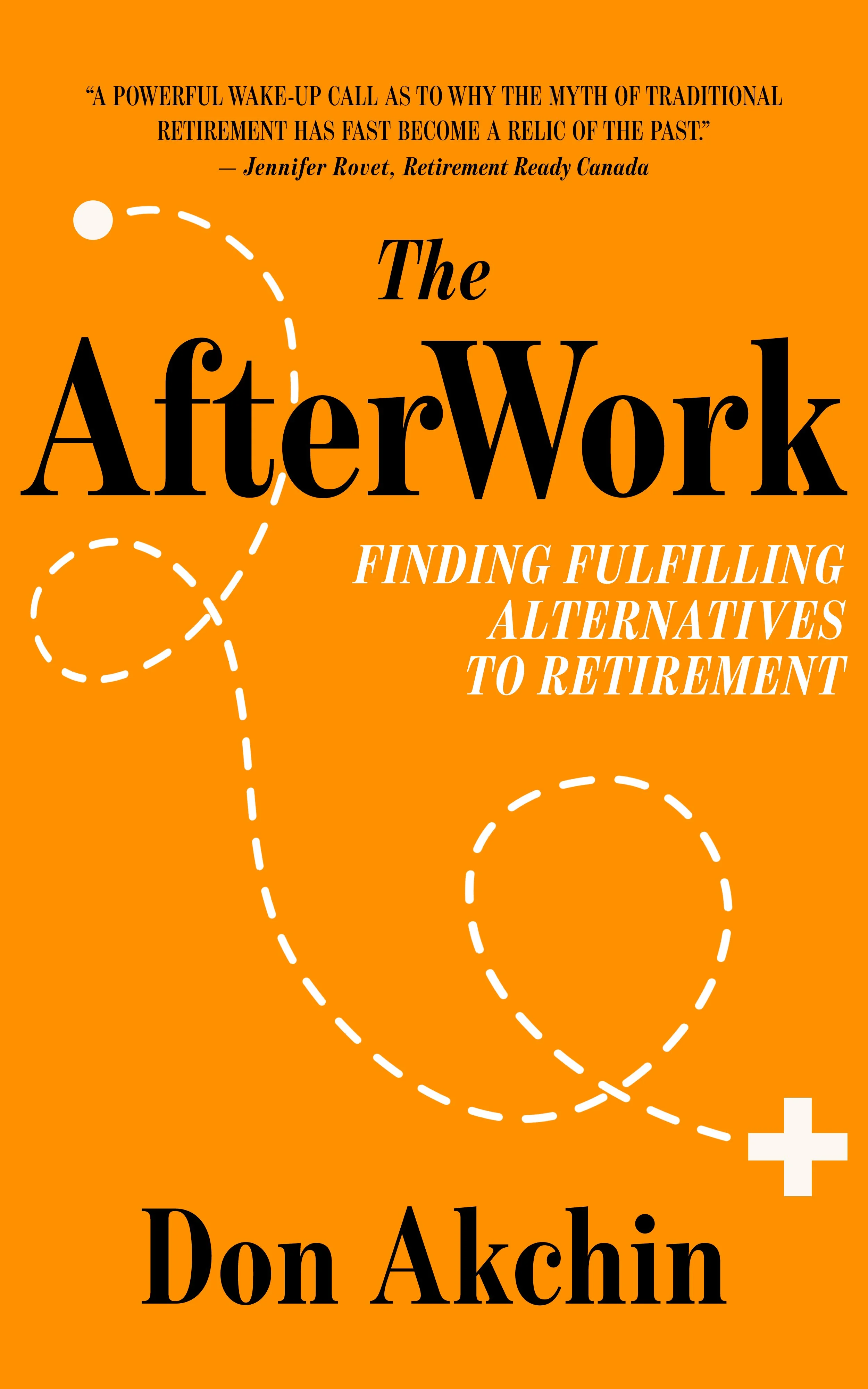
Retirement is dead.
Long Live. . .
The AfterWork
About The Book
A Fresh Perspective on Retirement
With more years of post-career living than ever before, you have many opportunities to fill those bonus years with great life-affirming adventures.
Real Stories, Real Insights
Freed from adulting obligations, you have license to try new experiences, test-drive a new career, maybe even start up a new business—with far less at stake if things don’t work out.
Practical Guidance
In this book you’ll meet others who made the transition from career to post-career and explore the range of rich alternatives you can choose from to make your AfterWork years fun and fulfilling.
What People Are Saying About The AfterWork
-Chip Conley, Founder of Modern Elder Academy and New York Times Bestselling Author
Older adults today face a very different world than previous generations when their careers conclude. Don Akchin illuminates the attractive choices awaiting those with the imagination and the flexibility to make their post-career years their best years.
-Jeanette Leardi, social gerontologist, community educator, public speaker, and author of Aging Sideways: Changing Our Perspectives on Getting Older
If you’re thinking about retiring from your job or longtime career but find the prospect daunting, how can you decide what to do and how to do it? Don Akchin offers some very practical –– and optimistic –– answers in The AfterWork: Finding Fulfilling Alternatives to Retirement. This book is a valuable manual that can help you evaluate your past experiences and current challenges in order to create a productive and satisfying next chapter that redefines what your “retirement” can be.
Constructing the foundation of a newer post-work life involves fitting together the vital building blocks of making choices, adapting to change, and maintaining your relationships. In The AfterWork, you’ll find many practical ideas that will bond these blocks together to form a stronger future you can enter with confidence and joy.
-Jennifer Rovet – Retirement Lifestyle Coach, Owner of Retire Ready Canada
Don Akchin’s new book, The AfterWork: Finding Fulfilling Alternatives to Retirement, is a powerful wake-up call as to why the myth of traditional retirement has fast become a relic of the past. In the "The AfterWork," Akchin helps you navigate through uncharted territories to discover for yourself a fulfilling and exciting next life stage, be it a new hobby, business, or just enjoying life. Insights for a smooth transition into the “AfterWork” are drawn from Akchin’s own personal story and those of dozens of others with whom he interviewed.
-Janine Vanderburg, CEO, Encore Roadmap
Whether you're approaching your second act, third stage, or fourth quarter, The AfterWork is the essential travel guide for what's next. In this compact yet powerful read, Don Akchin blends research, real-life stories, and practical, actionable advice to help readers navigate the many possible paths from traditional work to a fulfilling post-career life. What sets this book apart is its honest exploration of the relationship shifts that often come with this transition—especially when partners have different visions of life after work. This is the book I’ll be sharing with friends and colleagues who are asking, “Is this all there is?”—and who are ready to discover that the best may still be ahead.
Don Akchin is a former journalist and marketing professional whose career path was littered with potholes and zigzags until he discovered his own life purpose in The AfterWork.
He publishes The EndGame, a digital newsletter about aging with purpose and joy.
He lives with his wife in Baltimore, close to four grandchildren.
Talking about The AfterWork:
Here are the latest interviews I’ve given on The AfterWork and the book launch recording:

The EndGame is a weekly newsletter about aging with joy and purpose - in other words, making the most of our post-career lives. Topics range from physical and mental health to relationships, transitions, coping with technology, grandparenting tips, and much more.
My latest articles:free.
We’re Here, But the World Isn’t Ready for Us
Prepare to storm a few barricades.
Jan 17, 2026
In December, UK’s House of Lords issued a landmark report, Preparing for an ageing society, which concluded that an older populace is a permanent feature of modern societies globally, the result of longer lives and lower birth rates. The report attempts to take a systemic approach to the problem, seeing this as an economic and social transition.
What seems to worry the House of Lords the most is the economic fallout. Concerned about a shrinking workforce, the report calls for citizens to keep working for more years.
That framing raises the hackles of Jane Barratt, an international expert on aging policy, who argues that older adults have more value than merely as potential cogs in the economic machinery. “Ageing is primarily framed as a fiscal risk to be managed,” she complains. ”Paid work becomes the dominant signal of value. Care is recognized mainly for its impact on labor supply. Health is instrumentalized rather than held as a public good across the life course.”
On the other hand, at least someone in power is finally noticing. That’s a start.
Here’s the bigger picture, bird’s eye view:
We are enjoying longer lives, in greater numbers than ever before. But the world we inhabit was built for a different reality. As the Stanford Center on Longevity puts it, “100-year lives are increasingly common. Yet our institutions, economic policies, social and cultural norms have not kept pace.”
Stanford offers a calm, rational outlook. Then there’s the panic reaction: “We are witnessing the slow unravelling of three interconnected systems: health, wealth, and work,” write Mahad Safar and Adam Skali of the World Economic Forum. “Each is under pressure and each reinforces the others’ vulnerabilities.”
Let’s zoom in for a closer look at each institution and norm.
Work
Declining populations, either currently or projected soon, have nations scrambling to find more bodies to maintain their current workforce. Older adults enjoying longer and healthier lives would be a natural place to look for employees – as the House of Lords report suggests. Yet current employer policies – such as mandatory retirement age – are at cross-purposes with that pursuit.
Pivoting from one career field to another is already common. That would suggest a strong need for frequent intervals of further education and retraining – another practice not common to most business environments.
Healthcare
What allows the American healthcare “system,” a jerry-rigged Rube Goldberg-like conglomeration of disconnected parts, to function at all is the labors of millions of unpaid caregivers. (The costs of long-term care services and facilities, the only alternative for families, continue to reach for the stratosphere.) Being a caregiver restricts workforce participation and spurs earlier exits from the labor force. Meanwhile the system focuses its expertise and dollars on treating diseases rather than encouraging disease prevention through healthy lifestyle choices.
Personal finance
U.S. businesses have abandoned pension plans in favor of passing financial planning responsibility (and risk) onto employees through 401(k) plans. About 80% of older adult households lack the savings and investments to cover retirements of 20 to 30 years, or the reserves to weather a major healthcare emergency.
Higher education
Colleges and universities are designed to attract and serve recent high school graduates. Unfortunately for them, the next 10 years brings them face to face with the “18-22 demographic cliff,” a projected 15-20% drop in the traditional college-age population. Older adults with the time and interest to learn are a potential alternative to bolster enrollments, as are adults returning to learn new skill sets for career advancement or career change. But institutional change in academia makes snails look speedy.
In summary, it is our privilege (or burden, depending on your mindset) to go where no generation has gone before, and to go there long before the world is ready to accommodate us. Eventually, our frustrations may force institutions to reorient themselves to serve older adults. Perhaps our children’s generation will be the beneficiaries. Us? Not likely.
Nothing about this will be easy, in other words. We’ll have to be content with banging on doors and tearing down barricades to smooth a path for our descendants. Or, as songwriter Iris DeMent puts it, to be “working on a world I may never see.”